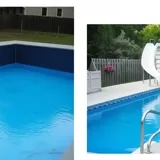
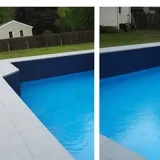
A liner replacement is not a cosmetic upgrade. Once a liner tears, wrinkles or stops holding water, the walls and floor behind it are exposed to constant moisture, and Davidson County's clay-heavy soil keeps that moisture moving. This page covers what a replacement involves, what it costs in Nashville in 2026, and the questions that separate an itemised quote from a surprise invoice.
What the job actually involves
A liner replacement is two jobs in one: removing the old liner and preparing the shell, then fitting the new one. In order, the work is drain-down, old liner removal, inspection of the walls and floor, repairs, liner installation, trimming around the skimmer, returns and light, then refill and water balancing.
The moment between removal and installation is the only time anyone can see the actual condition of the pool. That is why the repair list matters: rusted wall panels, a soft vermiculite floor, failed gaskets and cracks in the wall are invisible from above the waterline.
2026 installed costs in the Nashville market
Published national figures put a liner job at about $5 per sq ft installed, and $7 per sq ft in premium markets. Ranges by pool size:
| Pool size | Surface area | Installed cost |
|---|---|---|
| 12 x 24 | 288 sq ft | $1,300 - $2,300 |
| 16 x 32 | 512 sq ft | $2,100 - $3,000 |
| 18 x 36 | 648 sq ft | $2,400 - $3,700 |
| 20 x 40 | 800 sq ft | $3,000 - $5,500 |
A standard rectangular inground pool lands between $3,000 and $5,500 for the replacement itself, or $4,000 to $6,500 when the refill water is included. Large or custom pools run $6,500 to $9,000 and up. The national average for a liner replacement sits near $2,590, with most homeowners paying between $1,244 and $3,977.
Where the money goes
Labour is roughly 40% of the total. For an inground pool that is $1,000 to $2,500; for an above-ground pool, $250 to $800. The liner material runs $1,200 to $2,100 for a standard inground pool, and a premium 30-mil liner can reach $4,000 before labour.
Extras that appear on a good quote as separate lines, not as surprises:
- Refill water: $60 to $350 on city supply, or $400 to $900 trucked in
- Startup chemicals: $80 to $200
- Old liner disposal: $75 to $200
- Skimmer, return or gasket repairs: $100 to $400
- Floor patching or vermiculite repair: $150 to $3,000 depending on damage
- Rush liner order: $200 to $500
Hidden repairs found after drain-down commonly add $400 to $2,000. Ask for the repair schedule before the new liner is fitted.
Why Nashville pools are hard on liners
Davidson County soil is clay-heavy, drains slowly and can shift over time. Expansive soils move with moisture, and that movement works on pool walls, floors and coping. When groundwater pressure builds behind a liner during a wet stretch, the liner can float; when the clay dries and shrinks, the shell can settle.
The practical consequences for a liner job: drainage around the pool matters as much as the liner itself, wall and floor repairs are more likely to be needed, and a liner that is fitted without checking the shell is a repeat problem waiting to happen.
Do you need a permit in Nashville?
A liner-for-liner swap is a maintenance replacement and normally needs no permit in Tennessee. Replacing wall panels, changing the shell, adding or altering an underwater light, or any work on the equipotential bonding does require a Davidson County permit and inspection - Code Enforcement at LUESA issues building, electrical and plumbing permits here, and the county Public Health department approves pool construction. Confirm the scope in writing so nobody assumes the other party filed.
Questions to ask before you sign
- Who measures the pool, and what happens if the liner does not fit?
- How old is my pool, and how does the shell condition affect the projection?
- Which liner type, mil thickness and bead system are you quoting?
- What is fully included for wall and floor repair, and what is a change order?
- Are the refill water, chemicals and disposal on the quote or extra?
- What is your workmanship warranty, separately from the manufacturer's liner warranty?
Frequently asked questions
How long does a pool liner replacement take?
Measurement and ordering typically take 2 to 5 days, then 5 to 15 days for the liner to be made or shipped. The on-site work is usually a few days: drain-down and removal, repairs, installation, then refill. Stock above-ground liners arrive faster than fabricated inground liners.
Can I keep the water in the pool?
No. A vinyl liner is fitted to the shell and trimmed around the fittings, so the pool has to be drained. That is also why liner work tends to be seasonal: the pool is out of service until it is refilled and balanced.
Is a liner replacement cheaper than resurfacing?
Yes. Published figures put liner replacement at a fraction of a concrete or fibreglass resurface, which can reach $10,000 to $30,000. A liner swap is a repair; a resurface is a rebuild.
Do I need to be home?
Not for the whole job, but be available when the old liner comes out. That is the one point where repair decisions get made, and they are much cheaper when agreed before the new liner goes in.